 Algérie
 Égypte
 Nigeria
 Afrique du Sud

Who is expected to attend
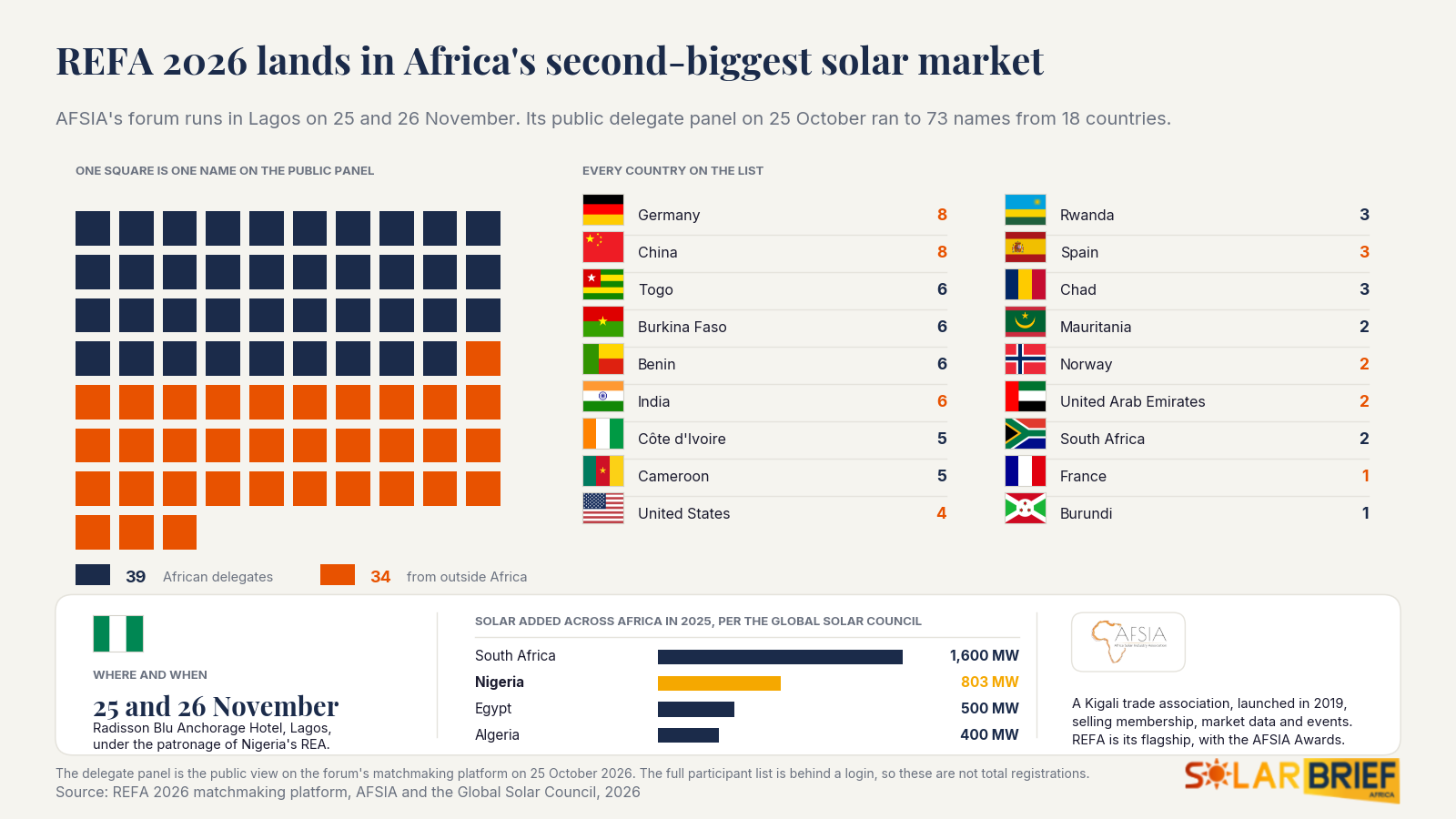
REFA gathers institutional and private investors, project developers, policy makers, utilities, regulators and corporates. The forum's public delegate panel listed 73 people from 18 countries on 25 October, led by Germany and China with eight each, then Togo, Burkina Faso, Benin and India on six, and Côte d'Ivoire and Cameroon on five. The full participant list sits behind a login. Eight national and regional bodies support the forum, among them South Africa's SAPVIA, Zambia's ZARENA, Cameroon's APELCA and Malawi's REIAMA. The equipment partners are mostly manufacturers: JinkoSolar, JA Solar, AIKO, AlphaESS and KUKA Cable, alongside Germany's Zimmermann PV-Steel Group, with support from SolarPower Europe.
Why it matters
Africa installed around 4.5 GW of solar in 2025, up 54% on the year, according to the Global Solar Council. Nigeria came second only to South Africa, with 803 MW against 1.6 GW, ahead of Egypt and Algeria. AFSIA's own Africa Solar Outlook 2026 counts 23.4 GW of verified operational projects and puts the continent's growth at 17% a year against a global average of 2%. That is the basis for the claim heard from the Accra stage that Africa is outgrowing China, Europe and the United States: it is a rate, not a volume. The agenda runs across utility-scale, commercial and industrial, storage, e-mobility, energy access, finance, policy and skills.
Why AFSIA organises it
AFSIA is a trade association, launched in May 2019 by John van Zuylen and based in Kigali, that sells membership, market intelligence and events. REFA is its flagship, and the AFSIA Awards are held on the first evening. Matchmaking is the point rather than the programme: delegates build profiles, browse the participant list and book meetings before anyone lands in Lagos. A two-day pass costs $700, or $250 for West African delegates, with further discounts through the supporting associations.
What it means
For a developer going to Lagos to raise money rather than to buy modules, the forum is worth the trip for one reason: the people with capital and the people with equipment are travelling to meet African projects, and the published delegate spread shows them coming from Germany, China, India and the Gulf while the projects come from West Africa. That is the trade REFA exists to broker, and the matchmaking platform is where it actually happens. Meetings fill before the doors open. Carry one caution into the room. The Global Solar Council puts Africa’s 2025 additions at about 4.5 GW; AFSIA’s own outlook says at least 2.4 GW. Both are trade bodies, both are estimating a market with poor visibility into rooftop and off-grid systems, and the gap between the two numbers is larger than Nigeria and Egypt’s 2025 installations combined. Growth is real and fast either way, but anyone quoting a continental figure across a table should know whose figure it is.
Sources: REFA, AFSIA, REFA, Global Solar Council, Africa Market Outlook for Solar PV 2026-2029, Rural Electrification Agency, DARES