 Nigeria, RDC, Kenya, Éthiopie, Tanzanie, Afrique du Sud, Panafricain
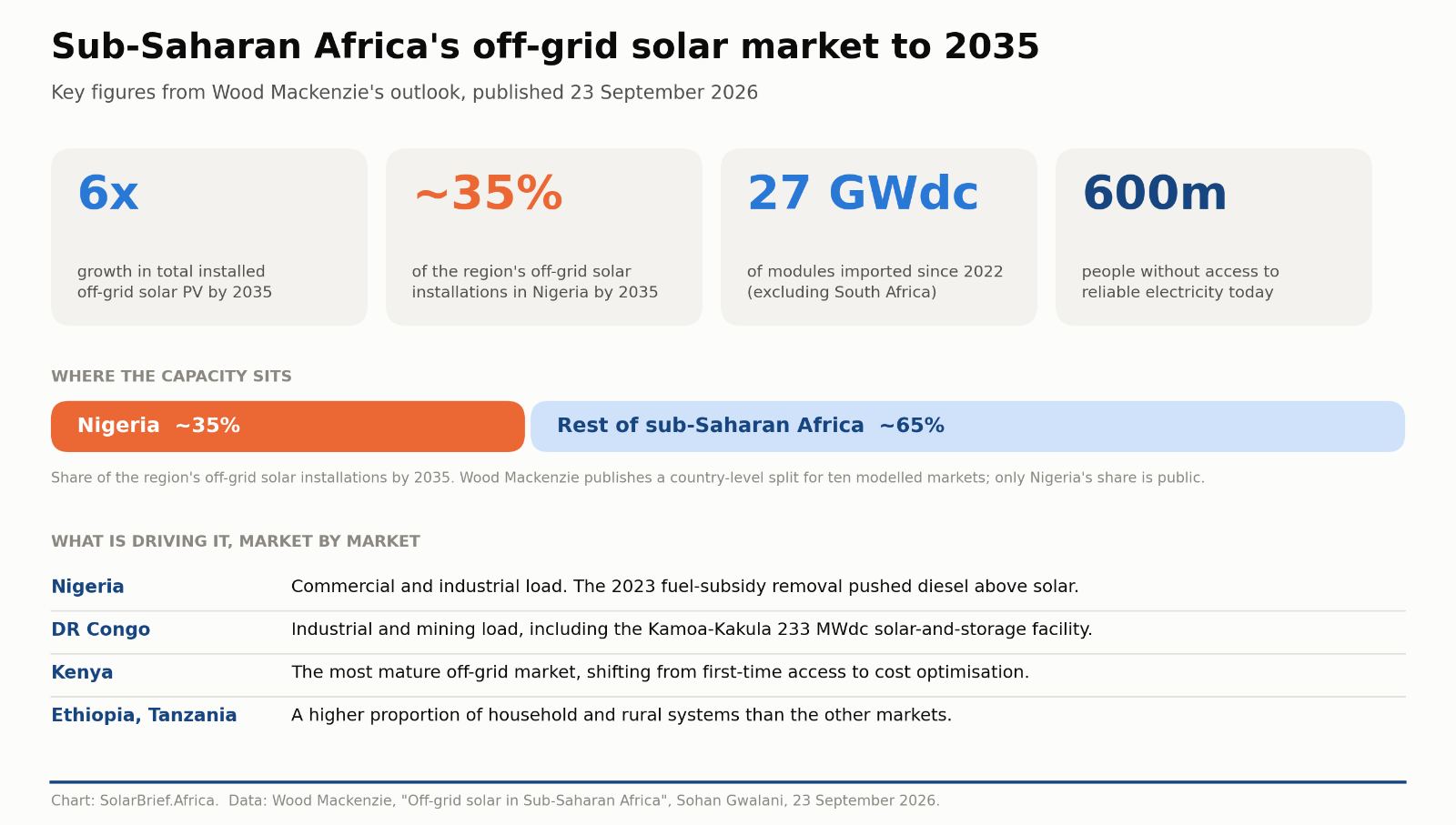
In sub-Saharan Africa, the term ‘off-grid’ is beginning to take on a different meaning. Less access in rural areas, more industrial investment. On 23 September, Wood Mackenzie published a market outlook forecasting that the total installed capacity of off-grid solar photovoltaic power in the region will increase sixfold by 2035 across the ten markets studied. Around 600 million people in sub-Saharan Africa still lack access to reliable electricity, and the capacity underpinning this forecast is not primarily intended for them.
Nigeria accounts for a third
By 2035, Nigeria will account for around 35 per cent of the region’s off-grid solar installations. The removal of fuel subsidies in 2023 has made diesel-powered self-generation sufficiently expensive that solar power has become more competitive for commercial and industrial users, thereby transforming a fallback market into a fully-fledged supply option. The DRC and Kenya follow for different reasons. In the DRC, the demand is industrial, with the Kamoa-Kakula copper complex being powered by an integrated 233 MWdc plant combining solar power and storage; Kenya, the continent’s most mature off-grid market, is moving from initial access to cost optimisation. Ethiopia and Tanzania still have a larger share of systems intended for households and rural areas.
Equipment is already arriving
Sub-Saharan markets, with the exception of South Africa, have imported more than 27 GWdc of modules since 2022, a volume unmatched in the region’s order book. Ember’s latest analysis estimates that distributed systems account for 75 per cent of all solar installations in Africa, with around 20 GW of the approximately 26 GW to be added between 2023 and 2025 located behind the meter. Joel Nana, from the Africa Tech Futures Lab interprets this development as being more the result of a crisis than of a planned strategy, a response to supply instability and costs rather than any sort of grid roadmap.
Funding sets the ceiling
Sohan Gwalani, the Wood Mackenzie analyst who authored this outlook, identifies funding as the limiting constraint on the 2035 target. Currency depreciation and double-digit interest rates are keeping the cost of capital high, whilst inconsistent rural electrification policies remain a persistent obstacle. None of these factors affects demand, which the forecasts take for granted.
What it means
For a developer or EPC firm drawing up its project portfolio for the next decade, these forecasts suggest that opportunities will no longer come from utility tenders. Whilst the bulk of new off-grid capacity is intended to serve industrial and commercial demand, the counterparties will be mine managers and plant finance directors, and the end product will consist of a captive power plant accompanied by a corporate power purchase agreement (PPA) or a lease agreement, rather than a competitive tender. This changes the internal skills required: assessing the creditworthiness of private buyers, structuring deals capable of withstanding currency fluctuations, and having sufficient balance sheet strength to finance construction. Companies designed to win tenders will find themselves competing for the smallest part of this market.
Sources: Wood Mackenzie, PV-Magazine, Solar Quarter