 Sénégal
Senegal is running three electricity programmes at the same time. Gas is replacing imported fuel, utility-scale solar with batteries is being procured through two separate channels, and solar mini-grids carry a rural access target set for 2029. Each has signed contracts behind it. Financing all three at once is the constraint that decides which of them actually gets built.
The three tracks do not sit on the same institution, which is the part that is easy to get wrong. Two of them run through Senelec, the national utility. The third runs through ASER, the rural electrification agency, and through private concessionaires that Senelec does not control and in places competes with. What they share is further up: one state, one ministry, one regulator and one queue of concessional lenders.
Gas is the track with momentum
In April, Senelec took 100% of West African Energy, whose 366 MW combined-cycle plant is expected to cover close to a quarter of national demand. The wider plan would take natural gas to 75% of installed capacity, through that facility and the conversion of a 335 MW plant. In September the northern segment of the gas network came online, roughly 85 km with capacity for up to 300 million cubic feet a day, fed from the Sangomar and Greater Tortue Ahmeyim fields.
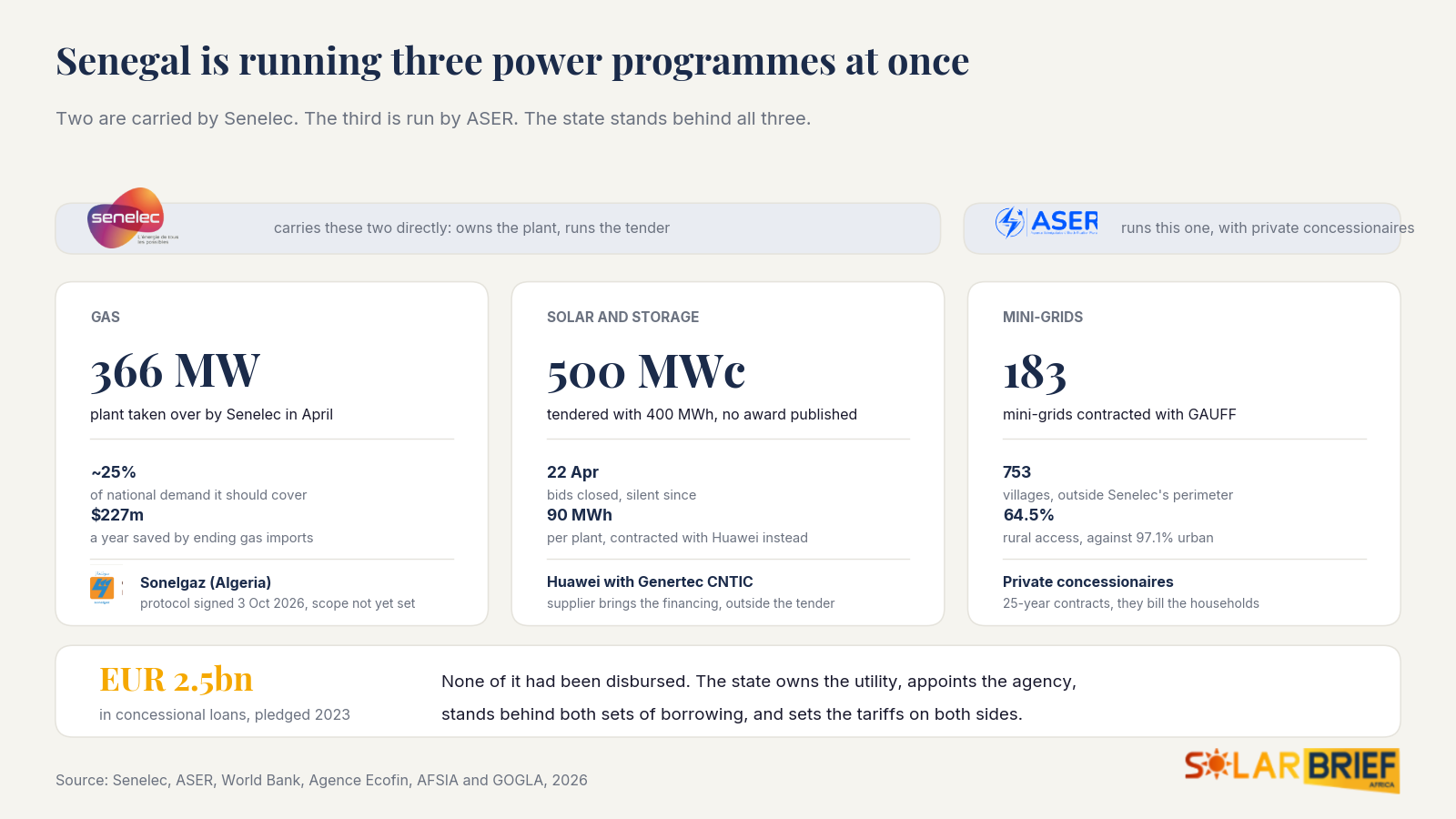
On 3 October, Senelec signed a protocol of cooperation with Algeria's Sonelgaz. Its scope, its target projects and its financing were all left unstated, and Algeria's energy minister Mourad Adjal offered expertise across the value chain rather than a contract. It is worth noting less for what it commits to than for what it signals about where Senegal is shopping for operating capability: Sonelgaz commissioned a 40 MW plant in Niamey in June and has begun an identical one in Chad.
The number that matters sits underneath all of it. Senegal expects to stop importing natural gas during 2026, saving around $227m a year. Against electricity subsidies of nearly $455m in 2023, that is the single largest piece of fiscal room the sector will see this decade. Whether it reaches consumers is undecided: the saving lands with Senelec and the regulator, CRSE, and nothing obliges either to pass it through.
Solar and storage is being bought two ways, and one has stalled
Senelec published a tender in February for 500 MWc of solar with 100 MW / 400 MWh of storage, at Linguère and Kolda, on an engineering, procurement, construction and financing basis. EPCF asks the contractor to bring the money as well as the plant, which is how a utility with a constrained balance sheet adds capacity without running a competitive independent power producer process. Bids closed on 22 April. No award has been published since, on Senelec's own procurement portal or on the platforms carrying the notice. That is not proof that no decision was taken, but it is close to six months of silence on the largest storage procurement in West Africa.
Capacity arrived anyway, through a different door. In April, Senelec confirmed a 50 MWc plant at Linguère with 30 MW / 90 MWh of storage, built by Huawei with Genertec CNTIC and expected to serve about 90,000 households. In August it signed a memorandum with Huawei for two further 50 MW plants, at Linguère and Koungheul, again with 30 MW / 90 MWh. A separate battery installation at Diass, backed by KfW and AFD, carries 30 battery containers and 360 converters for EUR 36m (FCFA 23.6bn).
The pattern is consistent. Where the supplier brings the financing, projects move. Where Senelec must run a competitive process and find the money itself, they do not. For a developer pricing a Senegalese bid, that means competing against a balance sheet rather than only against a tariff.
Mini-grids run through ASER, not through Senelec
ASER signed EUR 120m (FCFA 78.7bn) with the German engineering firm GAUFF for 183 solar mini-grids serving at least 753 villages, including household connections and indoor wiring. It sits inside a $225m programme accredited through the West African Development Bank, with $85.6m from the Green Climate Fund and a completion date of March 2028.
The commercial structure is different from the other two tracks and is often misread. ASER organises the concession tenders and provides subsidies covering part of the initial investment. Private concessionaires, on 25-year contracts with ASER and the energy ministry, build and operate the systems and recover tariffs directly from users. Senelec is not the retail supplier in these villages. The programme targets communities that lie outside the perimeter of both the Rural Electrification Priority Plan and Senelec, and the mini-grids generate their own power rather than buying it.
Senelec is not absent from rural electrification altogether. Where concession areas are connected to the grid, it sells bulk power to concessionaires at the medium-voltage tariff less 20%, and it extends the grid into rural areas on its own account. The World Bank has described that dual role, bulk supplier to the concessionaires and competitor to them, as one of the main obstacles the Senegalese model has faced. CRSE regulates concession tariffs as well as Senelec's, and has studied harmonising the two, which matters because concession tariffs sit above Senelec's residential rates.
The gap the programme addresses is the sharpest number in Senegalese power. National access reached 84% in 2023, but that splits into 97.1% urban and 64.5% rural. The first phase delivered 410 sites and 372 photovoltaic systems totalling 11.83 MWp and 46.24 MWh, reaching around 205,000 people. Universal access is targeted for 2029, which leaves three years to close a 35-point rural gap.
What it means
For an energy ministry or regulator watching Senegal as a model, the lesson is about sequencing rather than ambition. Running gas, utility-scale solar and rural mini-grids together is defensible, because each addresses a different problem and none substitutes for the others. What it does not do is spread the risk, because the institutional separation between Senelec and ASER is not a financial separation: the state stands behind both. The test arrives in 2026, when the end of gas imports frees roughly $227m a year. If that money goes to tariffs it buys political room, if it goes to the balance sheet it buys delivery capacity, and Senegal cannot have both.
Sources: Agenceecofin, Agenceecofin, Senelec, Senelec, World Bank: