 Maroc
 Égypte
 Nigeria
 Côte d'Ivoire
 Kenya
 Madagascar
 Djibouti
 Afrique du Sud
A module's price is negotiated to the cent. The cost of getting it there, rarely. Yet it is a purchasing line in its own right, and it varies twofold depending on the discharge port.
Measuring an underestimated cost
SolarBrief.Africa draws on the OceanMarketTrends market data from CEVA Logistics, one of the world's leading freight forwarders. It covers spot rates for a 40' High Cube container out of Shanghai, the main export port for Chinese modules and batteries.
Shanghai is not an arbitrary choice: most of the equipment installed in Africa comes from China, and freight is the last link in that chain still escaping any public measurement.
Eight destinations, one index
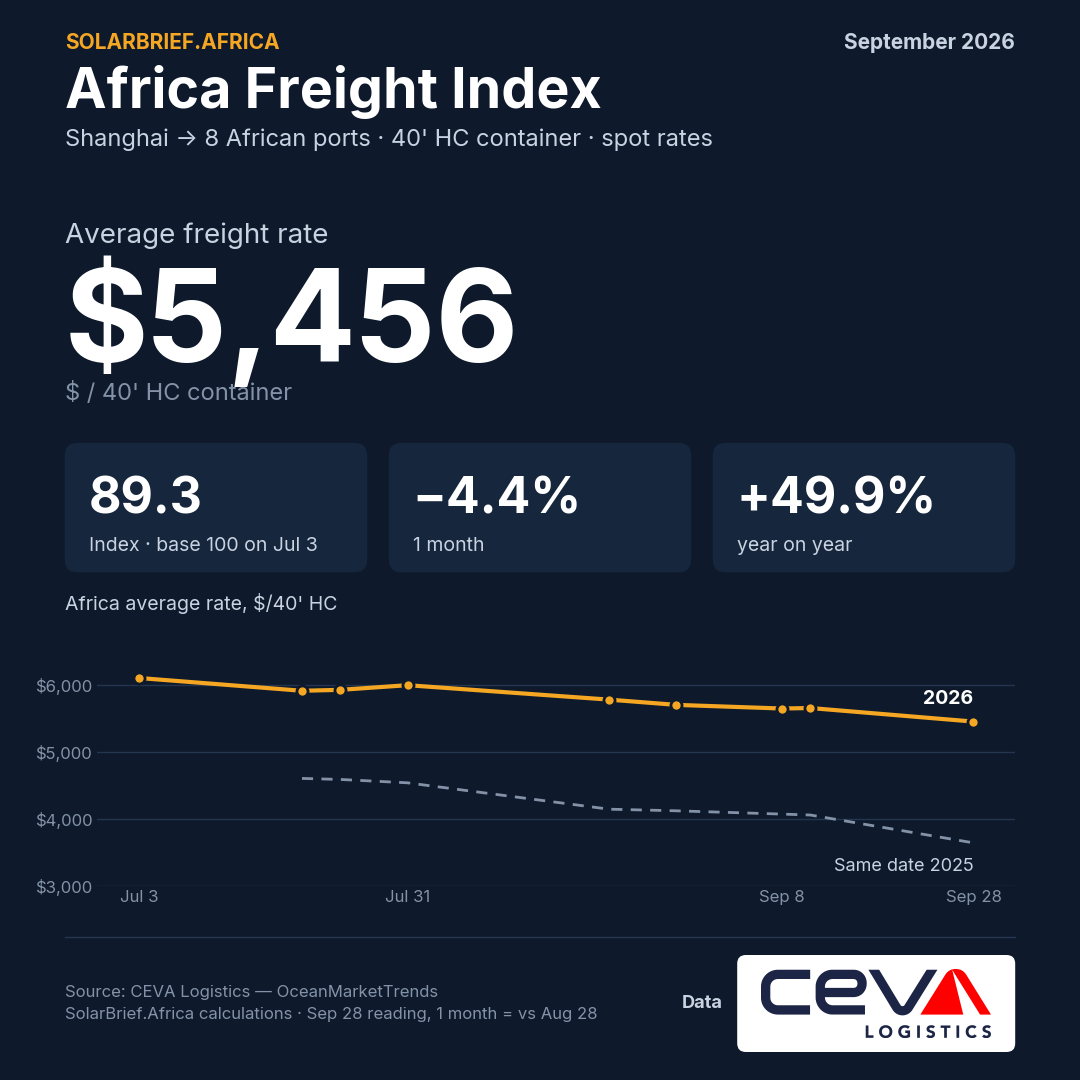
The basket covers Abidjan, Lagos, Djibouti, Mombasa, Port Said, Casablanca, Toamasina and Cape Town. From it SolarBrief.Africa derives an Africa average price, an Africa Freight Index, base 100 at 3 July 2026, and four regional sub-indices, with one-month and one-year trends.
The index is updated monthly and available at any time on our Deal Tracker, alongside module and battery prices and exchange rates.
September: the decline continues, freight stays expensive
At the 28 September 2026 reading, against the end of August:
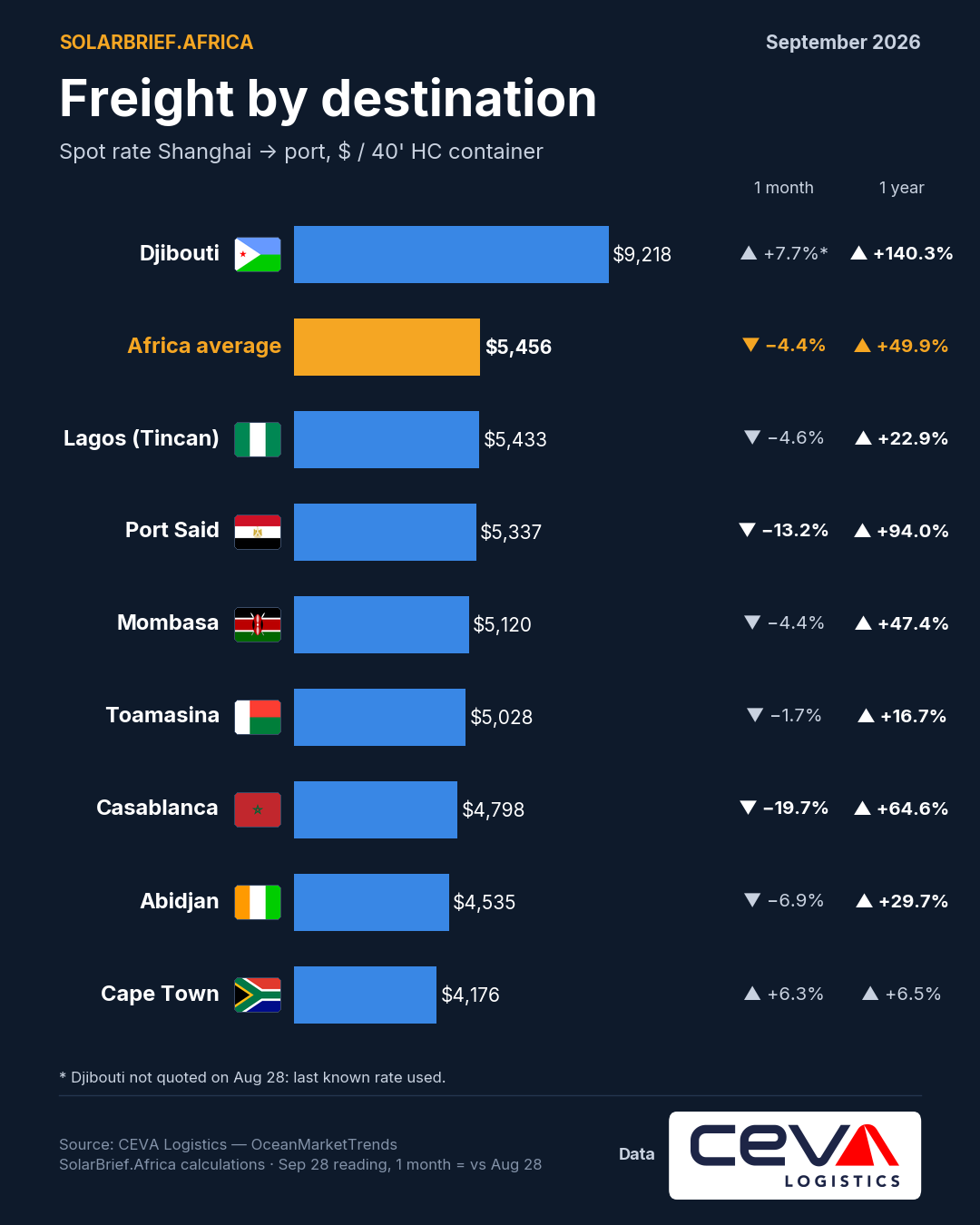
- $5,456 per container on average, down 4.4 % on the month and 10.7 % since July. September's readings average $5,589 (-2.7 %). Year on year, however, freight remains 50 % more expensive.
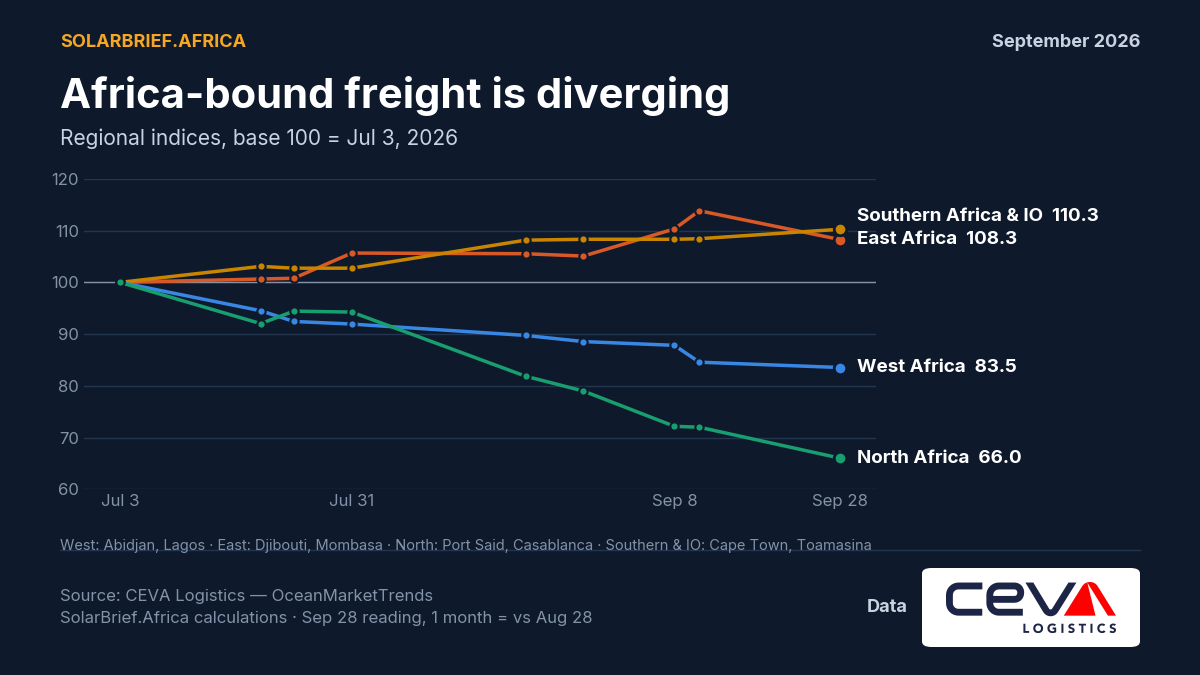
- North Africa leads the decline: -16.4 % on the month (Casablanca -19.7 %, Port Said -13.2 %). Its sub-index falls to 66, a third below July.
- West Africa follows at -5.7 % (Abidjan -6.9 %, Lagos -4.6 %).
- Against the trend in the south and east: Cape Town rises 6.3 % but remains the cheapest destination ($4,176). Djibouti stands apart at $9,218, up 140 % year on year and 1.7 times the African average.
What freight really weighs in a module's price
A 40' High Cube container carries around 400 kWp of modules, depending on dimensions and unit power. At September levels, freight therefore adds 1 to 2 US cents per watt to the landed price, depending on the destination port.
Set against a Chinese FOB price now around $0.114/Wp for an N-Type bifacial glass-glass module, that represents 9 to 18 % of the ex-works price. The gap is no longer marginal.
And it widens with destination. At the September reading, the container works out at 1.04 cents per watt to Cape Town against 2.30 to Djibouti. Between two buyers negotiating the same module at the same FOB price, one will pay nearly 1.3 cents more per landed watt, for no reason other than the port.
First October readings
At 9 October, the average price falls further, to $5,300 (-2.9 % against end September). Djibouti drops to $7,995 (-13 %), while Cape Town (+11 %) and Toamasina (+7 %) become more expensive. These figures will be consolidated in the October review.
FAQ
A monthly index tracking the cost of a 40-foot High Cube container out of Shanghai to eight major African ports, based on OceanMarketTrends data from CEVA Logistics. Base 100 at 3 July 2026, with four regional sub-indices.
Around 1 to 2 US cents per watt at September 2026 levels, or 9 to 18 % of a Chinese FOB price around $0.114/Wp. The calculation assumes a container carrying close to 400 kWp of modules.
At $9,218 in the September reading, Djibouti sits at 1.7 times the African average and is up 140 % year on year. It is the most exposed destination in the basket, while Cape Town, the cheapest, is at $4,176.
What it means
A module's real cost is built in four tiers: FOB price, freight, import duties, distributor margin. Comparing offers on FOB alone, or ignoring the discharge port, distorts the analysis. Transport belongs in the total cost of ownership from the purchasing stage, and it can now be tracked month by month.
Sources: CEVA Logistics, OceanMarketTrends