 Maroc, Algérie, Égypte, Nigeria, RDC, Afrique du Sud, Panafricain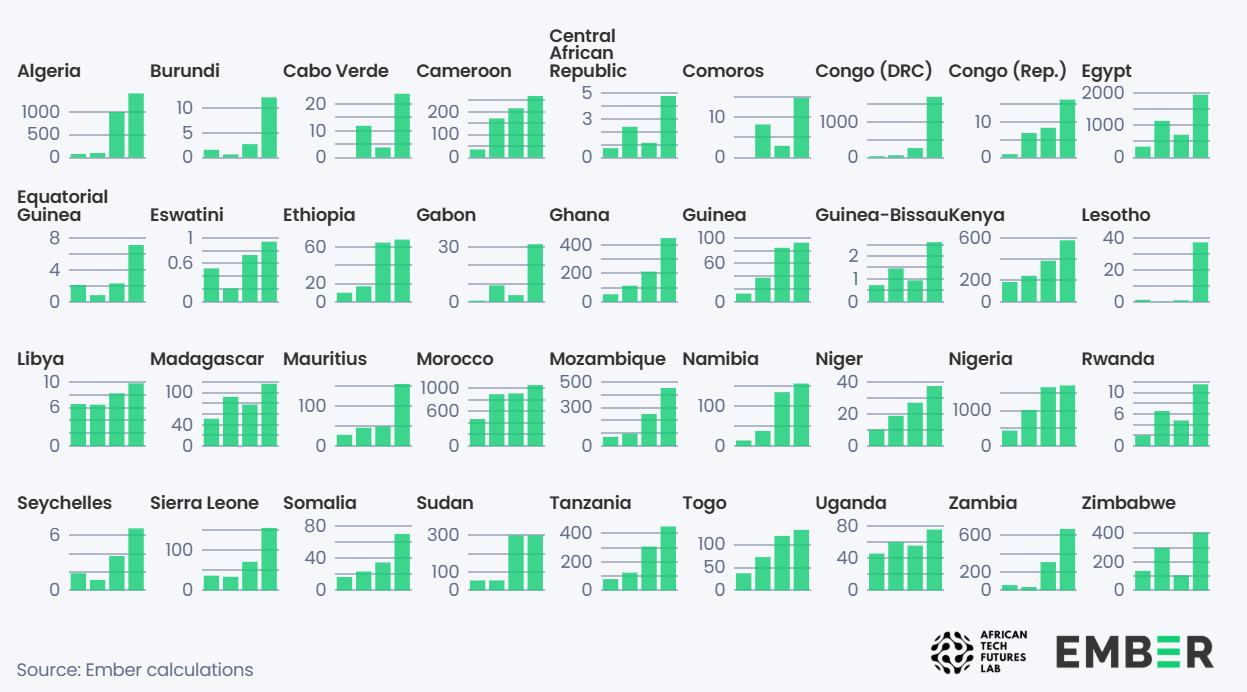
The end of the South African era
South Africa accounted for 52 per cent of African imports of Chinese solar panels in 2023. This year, it will account for less than 20 per cent of the continent’s installations – its lowest share since 2019 – whilst Africa as a whole will install a record 17 GW, representing a 45 per cent increase and a third consecutive record. Nineteen countries have more than doubled their installation volume year-on-year, led by the DRC (544 per cent), Zimbabwe (282 per cent), Egypt (176 per cent) and Zambia (117 per cent). Thirty-six of the 54 African countries are set to break a record.
The 5 emerging markets joining South Africa
Ember identifies six countries that will install at least 1 GW in 2026: South Africa with 3.3 GW, Egypt with 2.0 GW, Nigeria with 1.7 GW, the DRC with 1.7 GW, Algeria with 1.4 GW and Morocco with 1.0 GW. These figures are estimates and not reported installation figures. Ember calculates them using Chinese customs data, applying an installation rate of 73 per cent and taking into account a six-month lag between shipment and commissioning – an approach that may underestimate landlocked markets and overestimate coastal markets.
What it means
For developers in the energy sector, five markets outside South Africa now have a capacity of one gigawatt, and it is in the smallest grids that this capacity matters most. For public regulators, the scale of new capacity in Senegal is outstripping the planning cycles intended to accommodate it. For development finance institutions (DFIs) and banks, portfolios focused on South African solar power now account for an increasingly small share of the continent’s total. For industrial users, supply in the order of one gigawatt is coming on stream in Nigeria, the DRC and Algeria – three markets where diesel has been the main source of power for years.
Sources: EMBER, EMBER, ESI-AFRICA, PV-TECH, FORBES AFRICA