 Égypte
How big it is, and against what
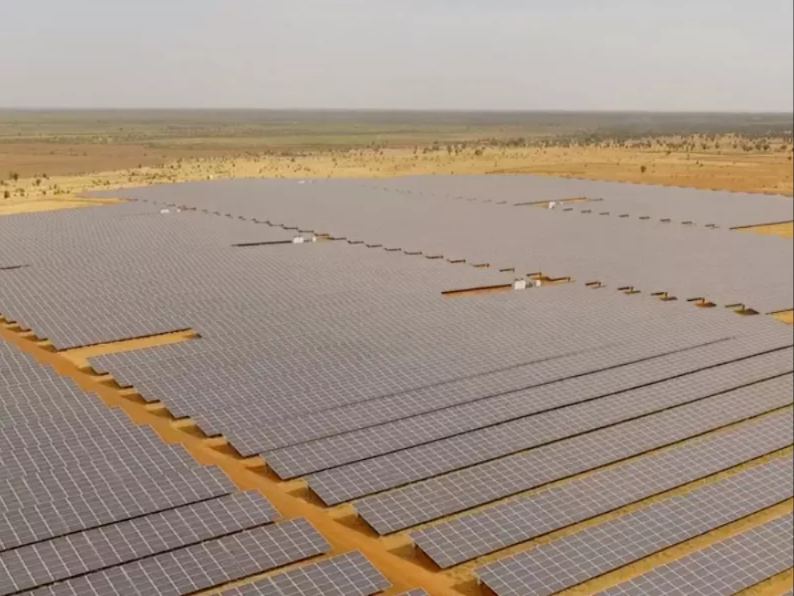
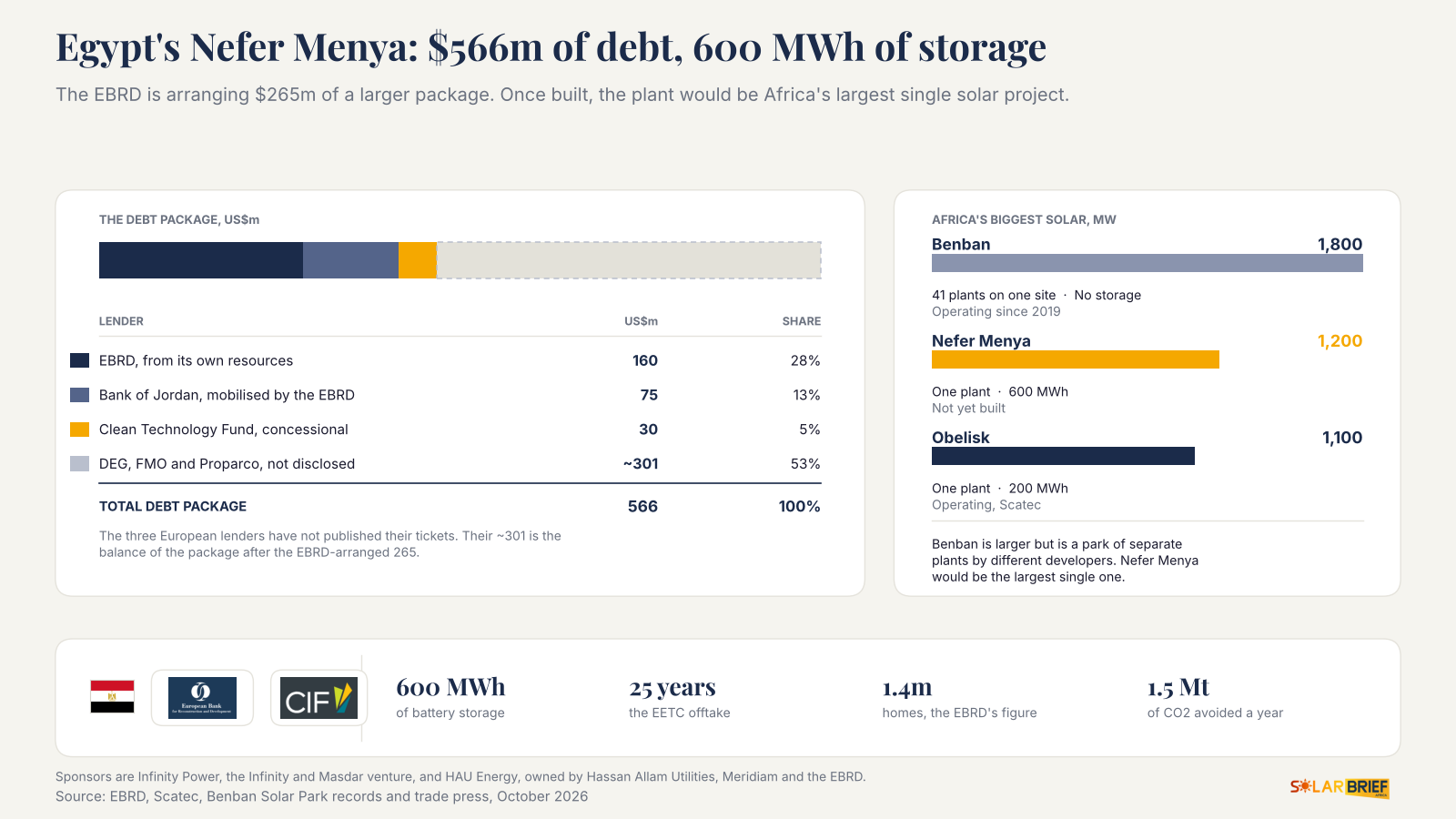
Nefer Menya pairs 1.2 GW of solar with a 600 MWh battery at Minya in Upper Egypt, held in a project company called Nefer Menya for Renewable Energy S.A.E. The EBRD calls it the largest solar PV and battery project in Egypt and Africa, and the qualifier carries weight. Benban, in Aswan, is bigger at 1.8 GW, but it is 41 separate plants built by different developers across one site. The largest single plant now running is Scatec’s Obelisk, at 1.1 GW with a 100 MW, 200 MWh battery. Nefer Menya would pass it on both capacity and storage, once built.
Who is paying for it
The EBRD is arranging up to $265m: a $160m A-loan from its own resources, a $75m B-loan mobilised from Bank of Jordan, and up to $30m of concessional money from the Clean Technology Fund under its global energy storage programme. The whole debt package runs to $566m, with DEG, FMO and Proparco alongside, which leaves about $301m between those three by subtraction, since their tickets are not published. The sponsors are Infinity Power, the Infinity and Masdar venture, and HAU Energy, owned by Hassan Allam Utilities, Meridiam and the EBRD, so the bank is both lender and shareholder.
What Egypt gets
Output is sold to the Egyptian Electricity Transmission Company on a 25-year agreement. The EBRD puts the plant at more than 1.4 million homes supplied and over 1.5 million tonnes of CO2 avoided a year. It sits under the energy pillar of Egypt’s Nexus of Water, Food and Energy platform, launched at COP27, which targets 10 GW of new privately built renewable capacity and the retirement of 5 GW of inefficient thermal plant. Clean Technology Fund technical assistance also funds two accredited green-skills courses for young people in Minya.
What it means
For a lender, the number that stands out is 600 MWh, not 1.2 GW. Obelisk carries 200 MWh against 1.1 GW of panels and sells to an aluminium smelter, while Nefer Menya carries three times the storage and sells to the national transmission company, which means the grid operator is now contracting for evening delivery rather than daytime energy alone. That is the shift worth pricing into the next Egyptian tender. Worth noting too that the EBRD sits on both sides, holding equity in one sponsor vehicle while leading the debt, and that roughly 53% of the package is visible only as a residual because the three European development banks have not disclosed their tickets.
Sources: EBRD, FundsforNGOs