 Nigeria
What was commissioned
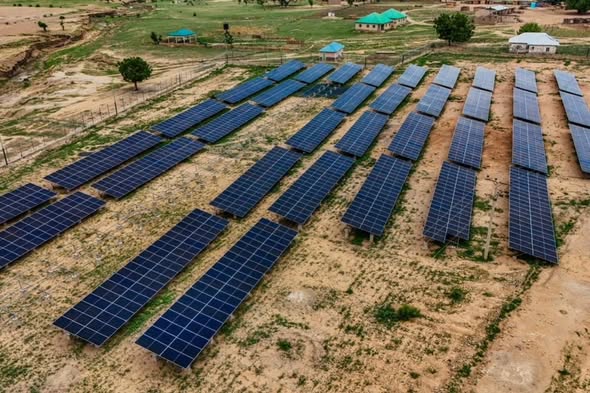
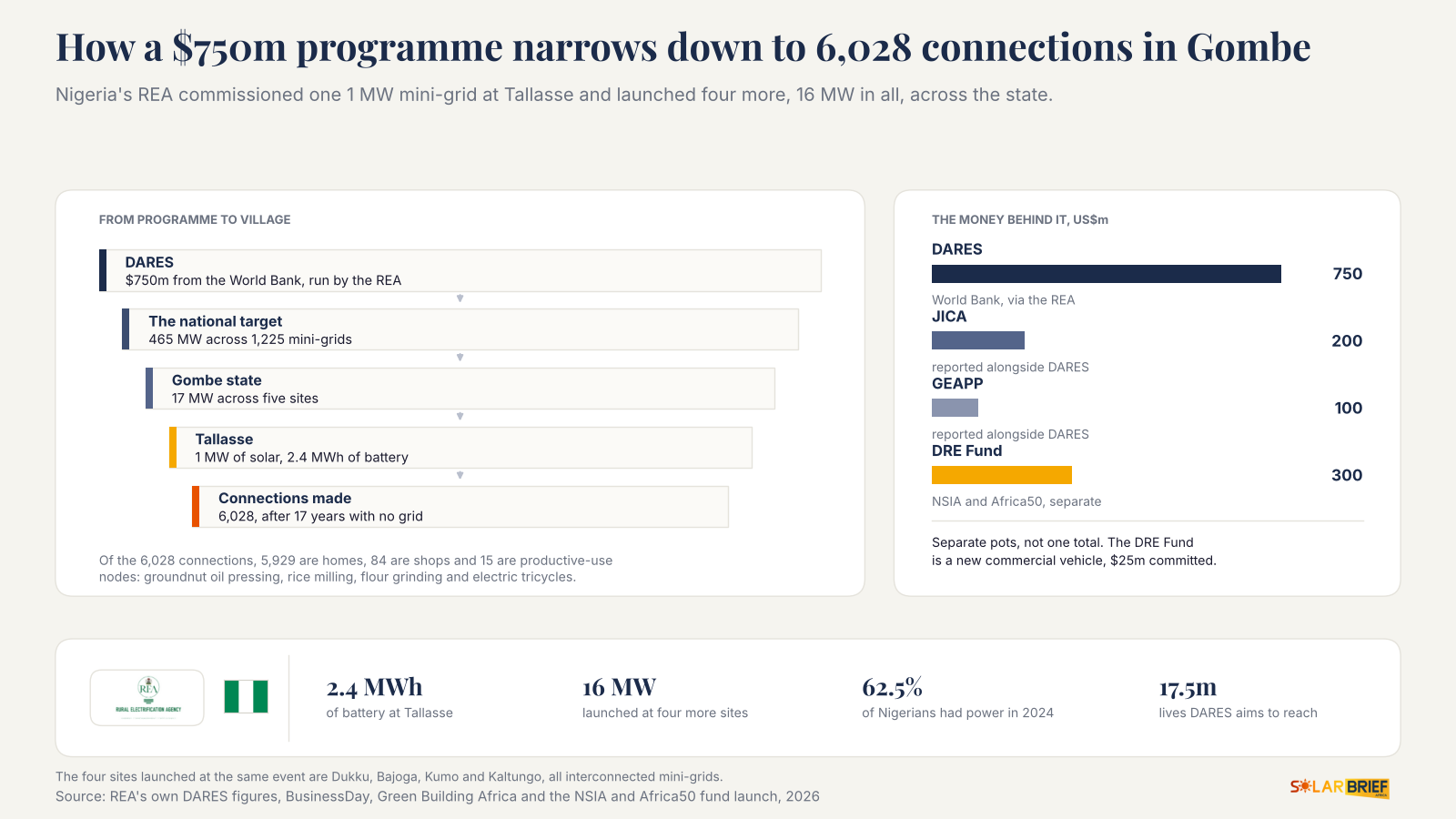
The Rural Electrification Agency commissioned a 1 MW solar mini-grid with 2.4 MWh of battery storage at Tallasse, in Balanga local government area of Gombe State, a community that had gone more than 17 years without a grid connection. It carries 6,028 connections: 5,929 homes, 84 shops and 15 productive-use nodes running groundnut oil pressing, modular rice milling, flour grinding and charging for electric tricycles. A private developer built it with the Gombe State Government.
What was launched
At the same event the federal government flagged off four interconnected mini-grids totalling 16 MW at Dukku, Bajoga, Kumo and Kaltungo. Joseph Tegbe, sworn in as minister of power earlier this year, tied them to the Renewed Hope Agenda covering Adamawa, Lagos, Oyo, Plateau, Kano, Kwara and Gombe, and asked host communities to guard the assets against vandalism. Abba Aliyu, REA’s managing director, said the programme is moving away from counting connections and megawatts toward economic outcomes, arguing that access without reliability limits impact.
Who is paying
Both sit under DARES, the Distributed Access through Renewable Energy Scale-up programme, which REA puts at $750m from the World Bank. Its own targets are 465 MW across 1,225 mini-grids, more than a million standalone solar systems, 236,986 MSMEs and 3.24 million households, of which 525,731 are headed by women, reaching 17.5 million people. Reported alongside it are $200m from JICA and $100m from the Global Energy Alliance for People and Planet. Separately, NSIA and Africa50 launched a $300m commercial fund for distributed renewables in September, with $25m committed so far by the World Bank through IDA.
What it means
For a mini-grid developer the interesting number at Tallasse is not the megawatt, it is the fifteen. Fifteen productive-use nodes against 6,028 connections is what gives a village system daytime load and a payback, and REA’s managing director is now saying publicly that the agency cares more about that than about connection counts. The 2.4 MWh battery on 1 MW of solar points the same way, at a system sized for milling and pressing rather than evening lighting. Anyone bidding into the rest of the DARES pipeline should expect productive-use commitments to carry more weight than headline megawatts.