 Maroc
 Côte d'Ivoire
 Sénégal
 Bénin
Background and footprint
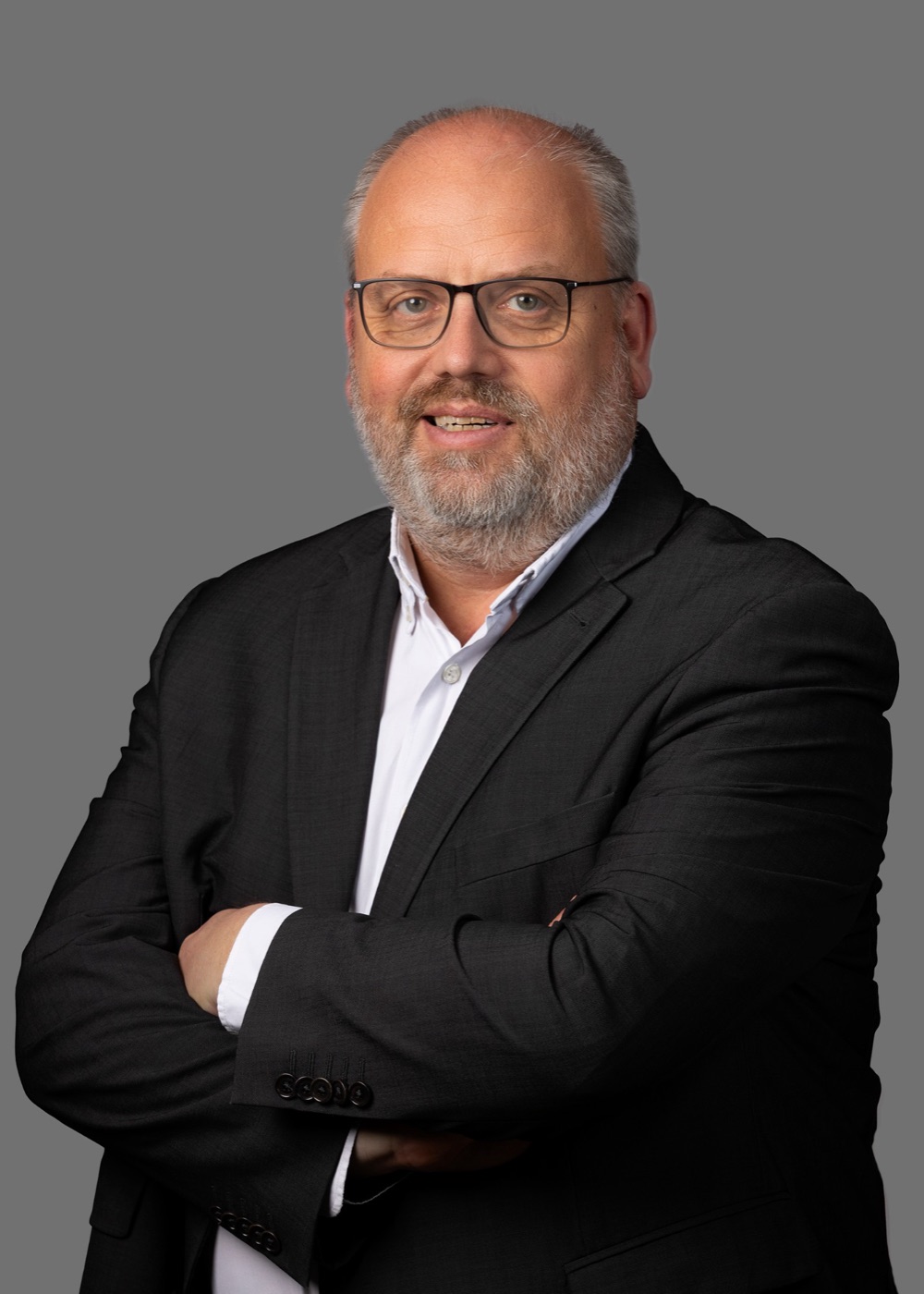
I am 56, trained as an engineer in automated systems, and my whole career has been spent in Eiffage Énergie Systèmes subsidiaries, starting with my final-year internship. From the outset I worked on projects in Africa: remote control of medium-voltage networks in Togo and Benin, then as a commissioning engineer and project manager, but also in Madagascar and even Iceland. In 2006 I became production manager of a subsidiary near Strasbourg focused on distribution and electrification in Africa, on projects funded by European lenders and covering several hundred kilometres of lines.
The turning point was the 2010 photovoltaic moratorium, which gave us our first foothold in solar, including our first plant, in Lorraine, of several tens of MWp. I then moved into a commercial role and took part in developing one of the largest photovoltaic plants in France and Europe, 300 MWp at Cestas, built to a very tight schedule. Then, from 2016 to 2023, we built the largest plant in Mauritania, Senegal, Côte d'Ivoire and Benin.
In 2023 I took over a regional division of Eiffage Énergie Systèmes. Today it accounts for 99% of the branch's business in Africa, as well as all of its extra-high-voltage business in France.
Besides our presence in 10 European countries, Eiffage Énergie Systèmes has 8 subsidiaries in Africa. We have 300 permanent staff in Africa and have gone up to 2,000 employees through project-based contracts, with only around ten expatriates: a loyal and highly skilled local workforce is one of our main strengths.
We have subsidiaries in Morocco, Senegal, Côte d'Ivoire and Benin, and branches in Mauritania, Guinea-Conakry, Ghana, Togo, Congo-Brazzaville and the DRC: mostly French-speaking West Africa, with occasional projects in Equatorial Guinea, Mozambique and Madagascar. Since 2017 we have built 9 plants in Africa, around 900 MW in 10 years, not counting Noor Atlas, a 225 MWp project under construction in Morocco. Our strategy is to focus on the ten or so countries where we are well known and strongly established.
The Noor Atlas project
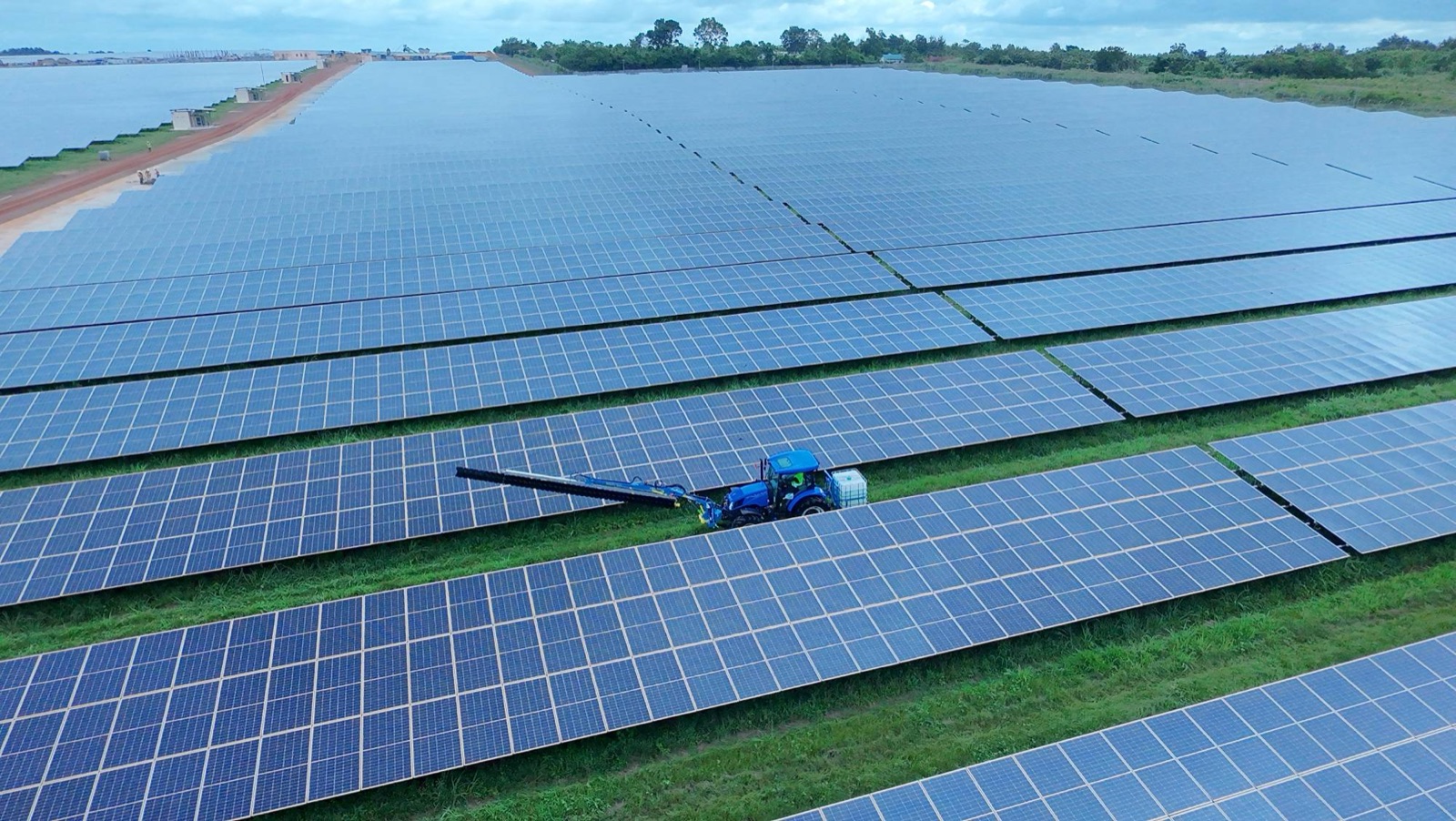
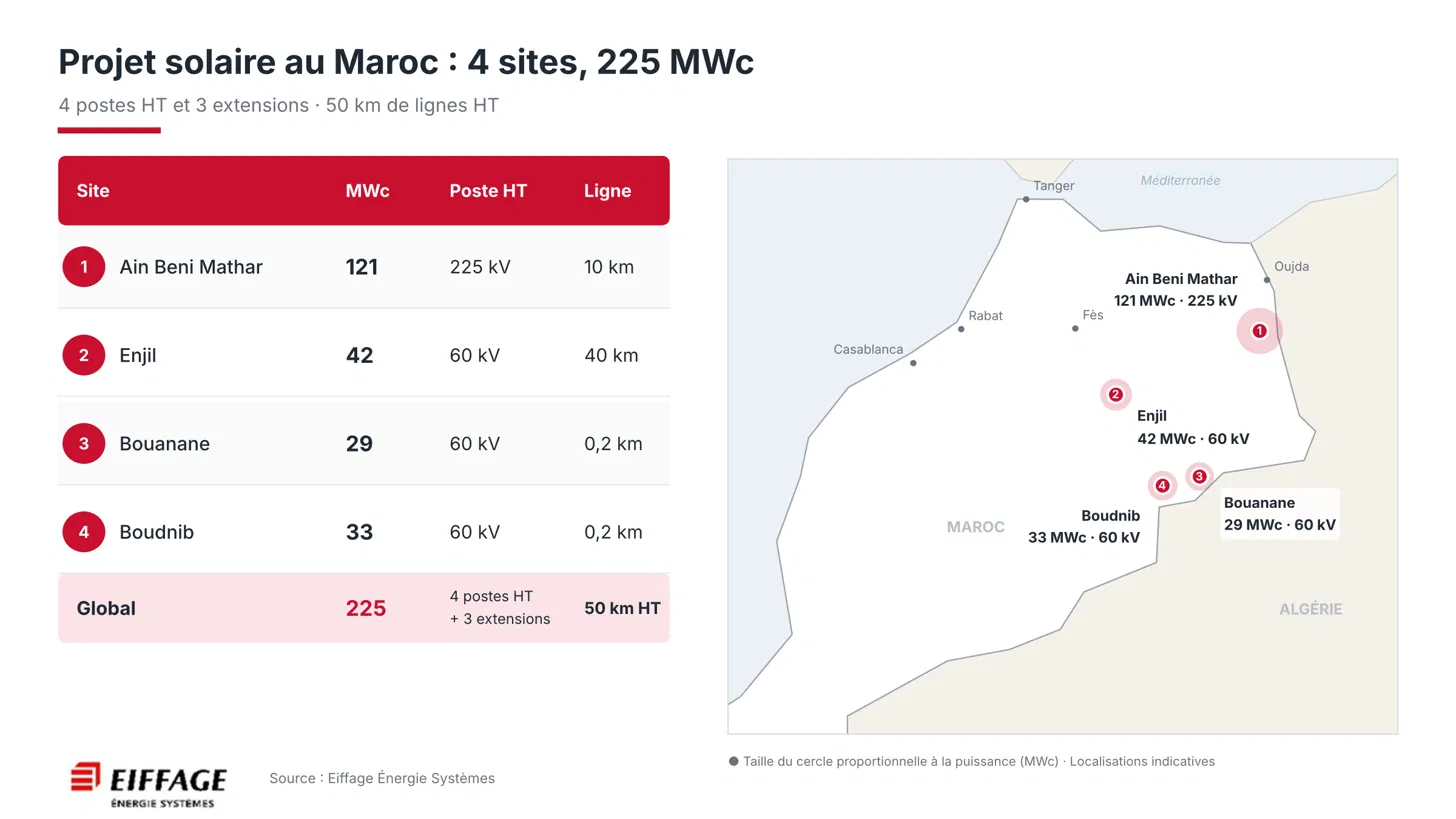
Masen launched a single tender in two lots; we won the lot of four plants, 225 MWp in total: Aïn Beni Mathar (121 MWp), Enjil (42 MWp), Bouanane (29 MWp) and Boudnib (33 MWp). On top of that come four high-voltage substations, three extensions of existing substations and some fifty kilometres of high-voltage lines, on fairly remote sites.
We submitted our bid in November 2023; the negotiation was long, with a technical and demanding client. We learned in August 2025 that we had been selected and signed the order in February 2026, with completion times of 11, 12, 15 and 18 months depending on the plant. We are on schedule: the first plant will be connected in January 2027 and the last in August 2027.
Masen's highly technical approach and its demanding standards allowed us to put forward a high value-added offer.
Noor Atlas is a mid-sized project, deliberately split into several plants connected at the end of the line, on radial feeders, to make power quality more reliable for outlying villages and towns. It would have been much simpler for us to build 225 MWp on a single site with a single substation: this split, which the client wanted, serves quality and the country's specific needs.
On a project of this size, the biggest difficulty remains logistics: you need experienced teams and trusted partners. That is one of our strengths: our teams are local, from management to the workforce.
From Europe to international markets, we reaffirm our position as a key partner for energy sovereignty and security. We have already delivered two storage projects in Africa: one in Côte d'Ivoire, at Boundiali, in operation for three years, the other in northern Senegal, at Bokhol, for Africa REN, in operation for a year and named African storage project of the year by AFSIA in 2025. In France, we will have installed more than a gigawatt-hour of batteries within three months: it is not just a container you set on the ground and wire up. This shows our end-to-end expertise, from extra-high voltage to smart systems, and we deploy it where the energy challenges are toughest.
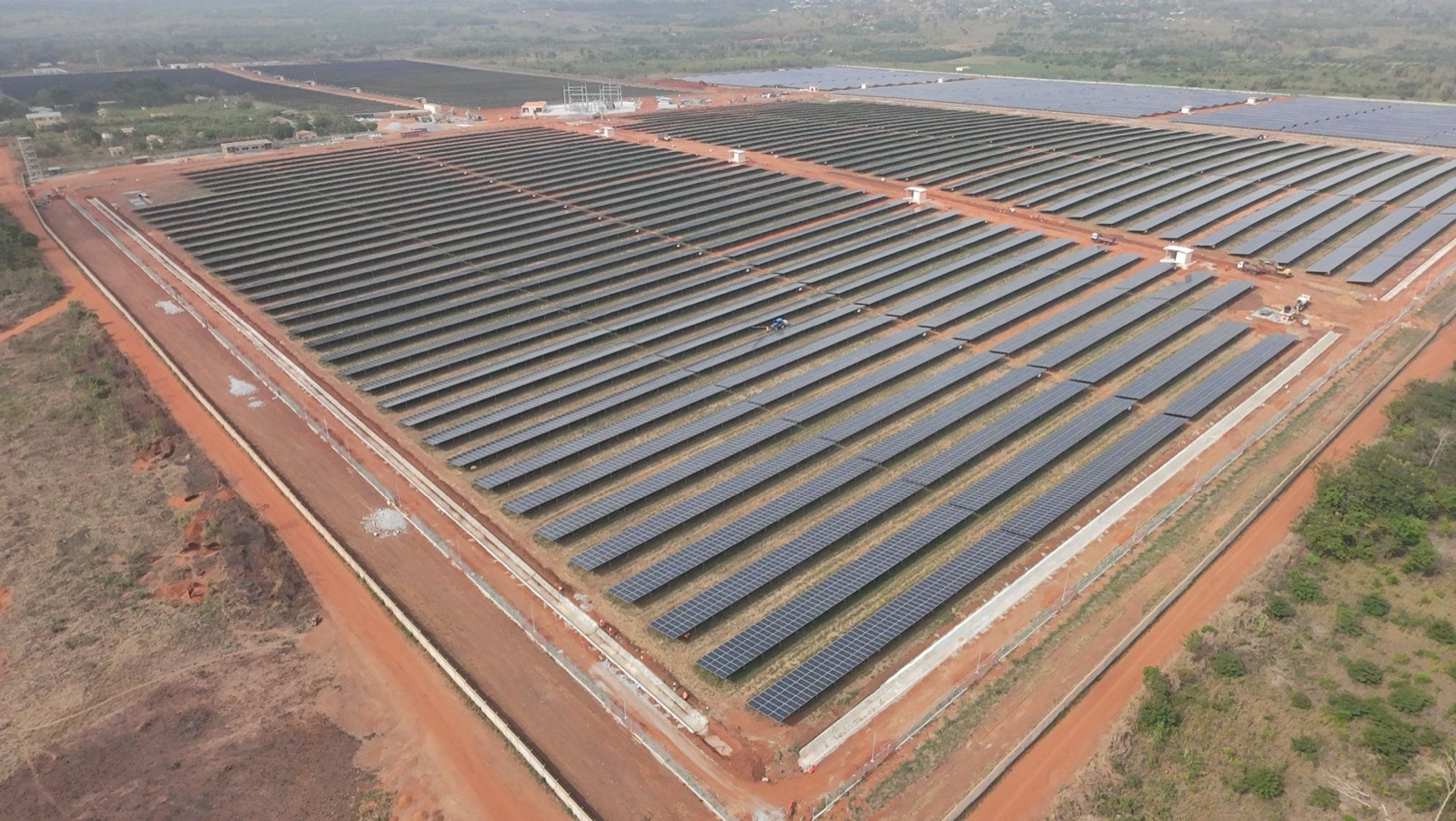
Our difference is putting expertise at the heart of our offer. That also means meeting deadlines and building a bid around a complete view of the project, to avoid unpleasant surprises. On Noor Atlas, this phase took time, to make sure of the quality of the modules and the rest of the equipment, with European suppliers, notably for the structures (trackers from Germany's Zimmermann).
Our reputation matters too: it takes a long time to build and little time to lose, which is why we cannot afford to fail on a project. Finally, we offer a complete package (photovoltaics, export substation and now batteries) delivered by a single entity, which simplifies project management. High voltage remains a real skill that sets us apart.
A view on African solar
We have reached the end of "dry" solar development, without storage, in West Africa's mature markets, because the grids' capacity to absorb more solar has been reached. Storage is the next growth driver. Conditions are particularly favourable: land is available, and the steady fall in the cost of PV and battery technologies now makes a stored kilowatt-hour far more competitive than power from fuel-oil or diesel generators, which still weigh heavily on local energy mixes.
Batteries also improve power quality: frequency control, grid support, black-start capability. Today, strong frequency and voltage fluctuations age industrial equipment prematurely, to the point that some cement plants island themselves with their own diesel plant. This mix will be a major driver of development.
Supplying off-grid villages with photovoltaic and battery systems will also have its place, since many countries have electrification rates of only 50 to 60%, against more than 99% in Morocco. But off-grid raises more maintenance problems and, because it is much smaller than large solar plants, the kWh costs more: distributing it requires state subsidies to keep it affordable for consumers.
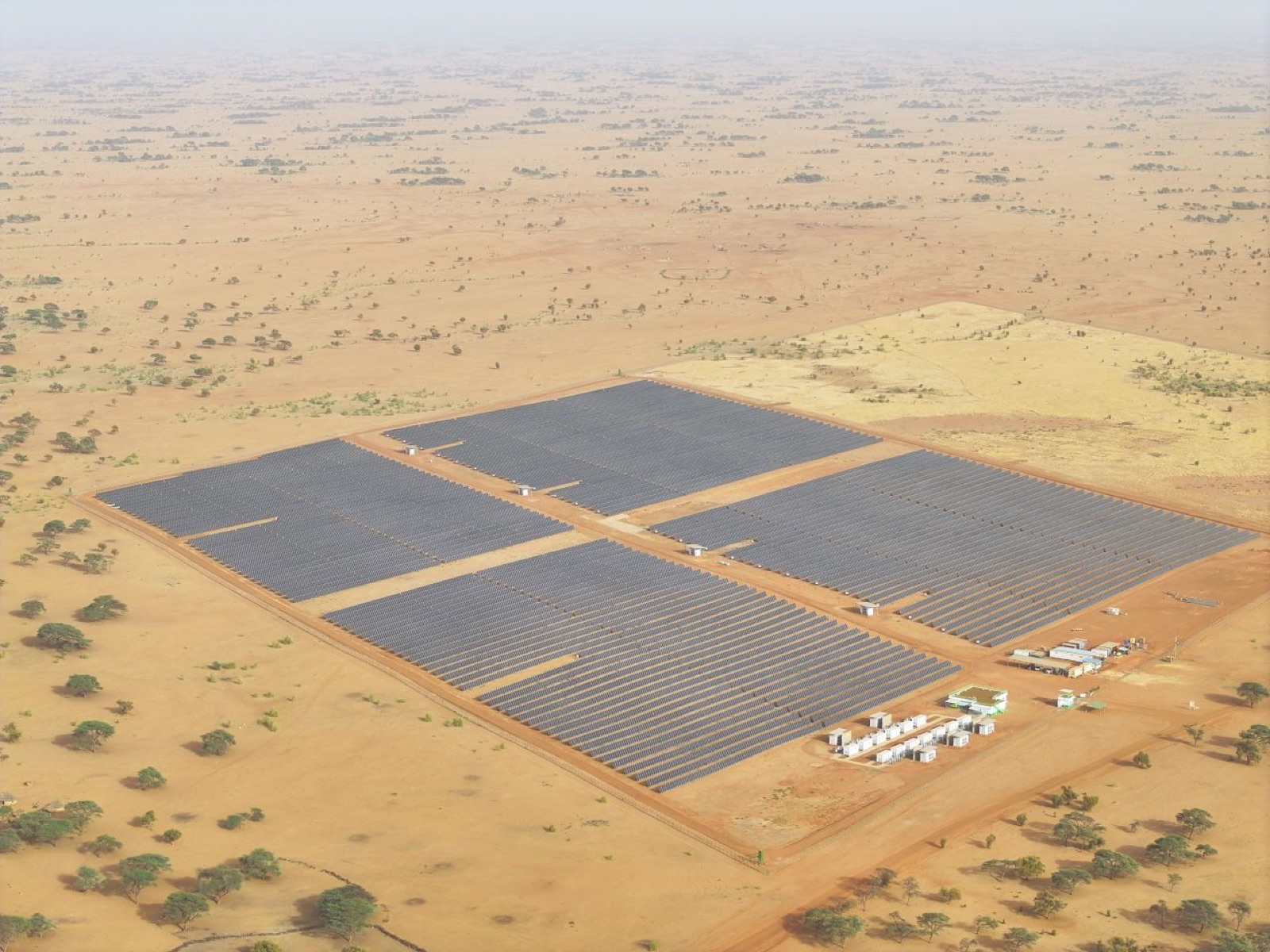
A decisive one, in my view: maintenance and operation, still below the level required for more complex installations (electronics, conversion, batteries). We see big differences in availability from one plant to another depending on who operates them: a culture of preventive maintenance needs to develop to prevent installations from ageing prematurely.
On financing, PPAs (power purchase agreements) in Africa require sovereign guarantees that add to state debt. I hope national utilities will invest themselves, but countries' economic health remains an obstacle: in some countries, budget difficulties are slowing new deployments. Conversely, countries such as Morocco, Côte d'Ivoire and Benin have real momentum and will be able to move faster.
Very high technical standards. Some PV plants have been built at very aggressive prices, without a sharp technical eye: on some, the maintenance contractors ended up throwing in the towel, there were so many construction defects. We have audited some of them: a plant barely two years old already had catastrophic availability, because of low-end equipment and technical choices. Solar pays back over 15 to 20 years: you have to do the right sums at the start, not cut corners and be demanding, otherwise you end up with installations that last 4 to 5 years.
Read also: Morocco: Noor Atlas, Eiffage builds 225 MW of solar to curb coal
Sources: Entretien avec Ludovic Bavière, Eiffage Énergie Systèmes, 6 octobre 2026