 Kenya
Kenya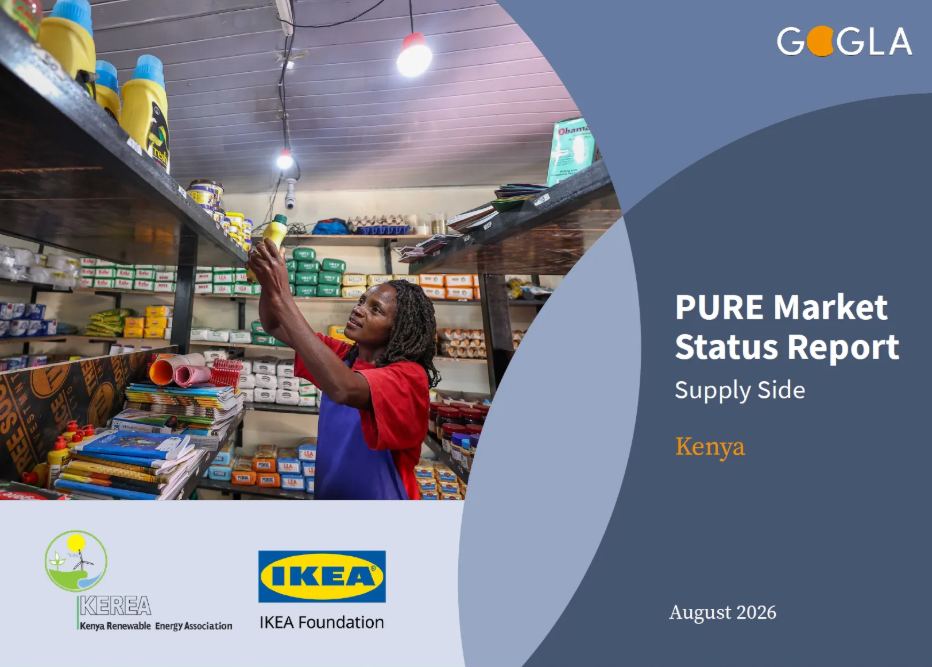
Kenya's electricity access rate passed 75% in 2024, with around 10% of the population connected through mini-grids or standalone solar rather than the national grid. GOGLA, the global association for the off-grid solar industry, supported a Kenya Renewable Energy Association (KEREA) survey of 54 companies supplying productive use of renewable energy (PURE) equipment: solar pumps, cold rooms, mills, incubators and similar kit bought to generate income rather than light. Funded by the IKEA Foundation and run from Q4 2024 to Q3 2025, it asked suppliers about business models, distribution channels, technologies, customer segments and sales.
Only the largest suppliers can lend
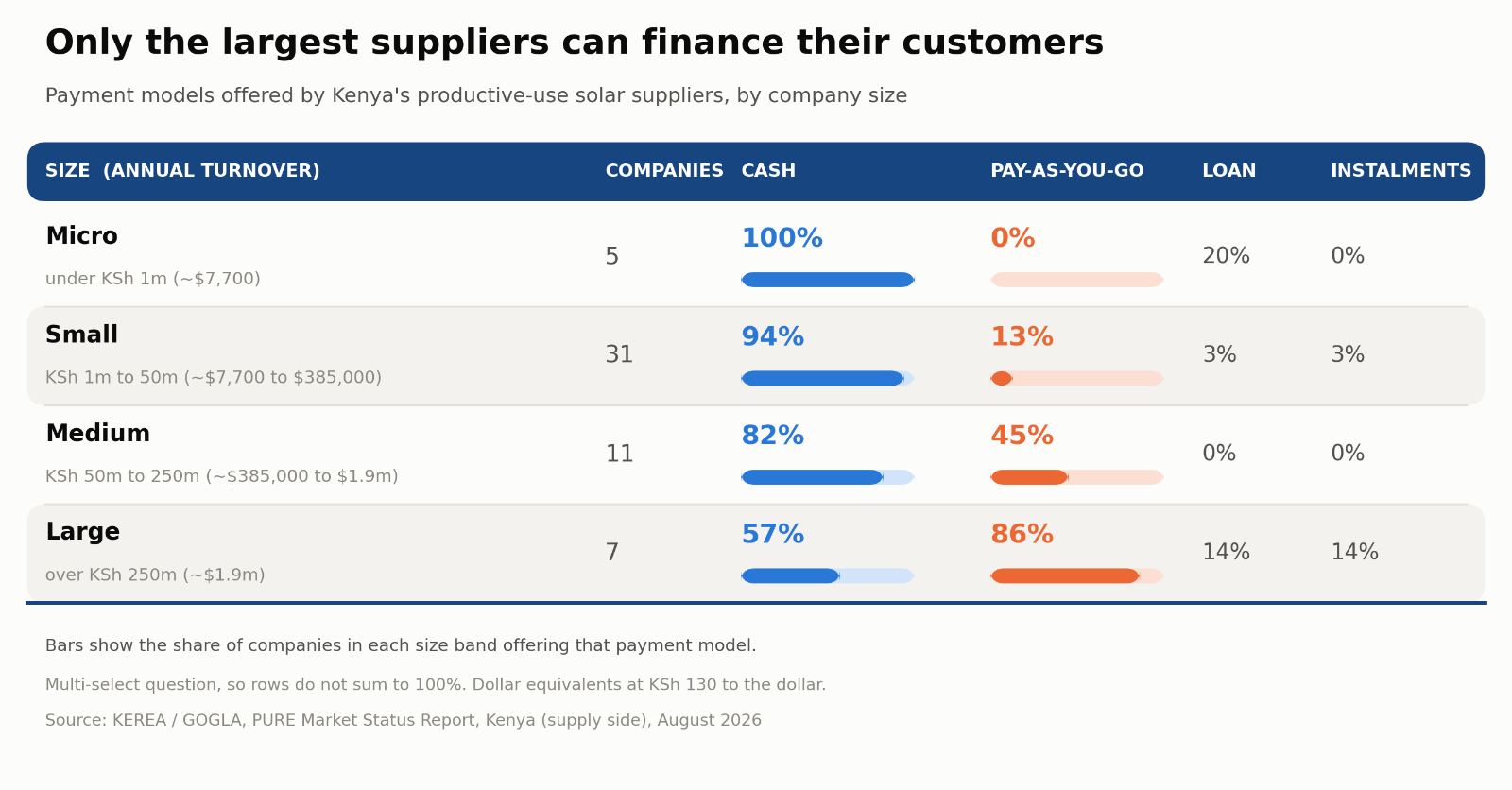
Pay-as-you-go reaches 86% of large companies, those above KES 250m (~$1.9m) in turnover, because they can prefinance customers from their own balance sheets. Among small companies, 58% of the sample, 13% offer it. Bank loans feature in under a fifth of firms in every size band, which the report attributes to weak partnerships with financial institutions. The pattern leaves the companies closest to rural customers least able to bridge the cost of equipment.
Priced above the mass market
Most PURE equipment sits outside the KES 1,000-25,000 (~$8 to $190) entry-level band where off-grid solar sells in volume. Pumps, chillers and cold rooms fall into brackets reaching KES 3m (~$23,000). High upfront cost, taxes and import duties, and local distributors short of working capital head the suppliers' own list of constraints.
Half the market has no distribution
52% of respondents engage no distributors or dealers and 50% use no last-mile agents, selling direct instead. Networks above 100 agents exist at 11% of firms, almost all large. Coverage follows the same shape: 89% operate in Nairobi against 26% in the North Rift and 22% in North Eastern, the arid counties where solar pumping and off-grid cold storage have the strongest case.
What it means
Demand is not the bottleneck in Kenya's productive-use market; financing is, and it binds at the supplier rather than the customer. A lender looking at this market will find that the firms with reach into arid and underserved counties are the small ones, and they are the ones selling for cash because they cannot carry receivables. Capital placed with the large PAYGo players buys scale in territory that is already covered. Working-capital facilities, receivables financing, or guarantees sized for KES 1-50m (~$7,700 to $385,000) companies would buy distribution that does not currently exist.
Sources: GOOGLA