The ‘National Energy Compacts’ (NEC) are the national action plans underpinning ‘Mission 300’, an initiative led by the World Bank and the African Development Bank (AfDB) aimed at connecting 300 million Africans to the electricity grid by 2030.
Developed and approved by national governments, these compacts set country-specific targets for expanding access to electricity and developing energy infrastructure, strengthening public services, rolling out decentralised renewable energy and clean cooking solutions, and attracting private investment.
By August 2026, 29 countries had finalised their NECs. The first twelve – Chad, Côte d’Ivoire, the Democratic Republic of the Congo, Liberia, Madagascar, Malawi, Mauritania, Niger, Nigeria, Senegal, Tanzania and Zambia – were unveiled in January 2025.
In September 2025, a further seventeen – Benin, Botswana, Burundi, Cameroon, the Comoros, the Democratic Republic of the Congo, Ethiopia, The Gambia, Ghana, Guinea, Kenya, Lesotho, Mozambique, Namibia, São Tomé and Príncipe, Sierra Leone and Togo – unveiled their agreements.
Solar Brief Africa reviews here some of the key targets to which countries have committed in their NECs.
Access to electricity.
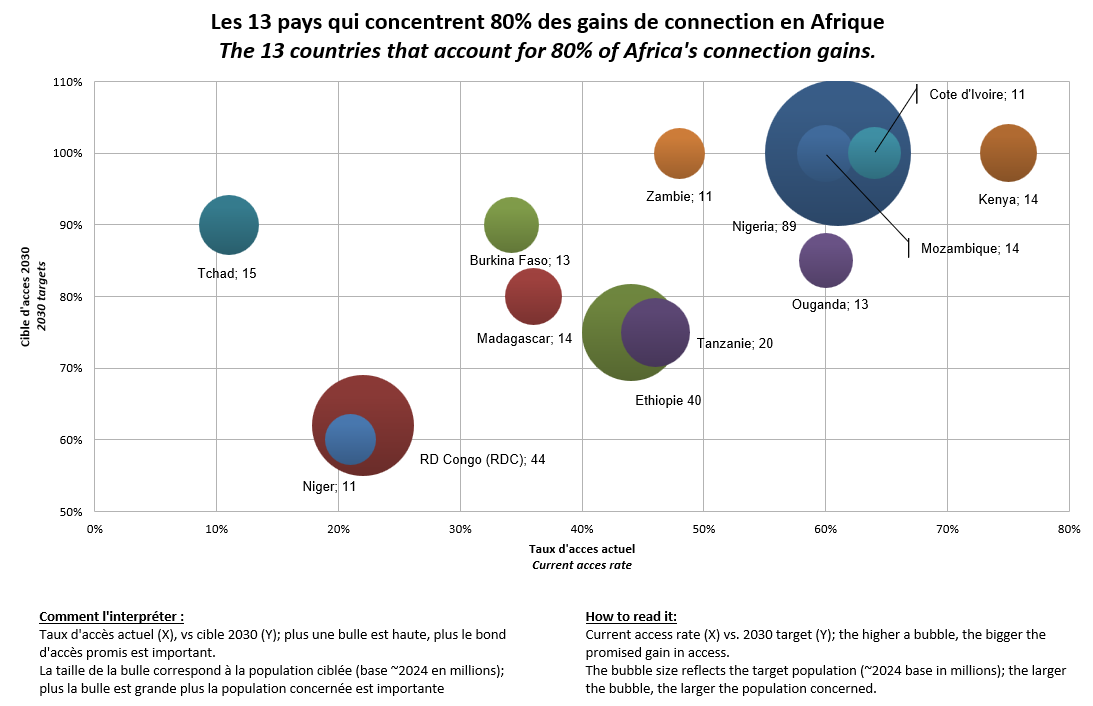
Expanding access to electricity is an integral part of many NECs, with the majority of the plans setting ambitious targets for the end of the decade. Botswana, Côte d’Ivoire, The Gambia, Guinea, Kenya, Lesotho, Mauritania, Mozambique, Nigeria, São Tomé and Príncipe, Tanzania, Togo and Zambia are all aiming for universal access to electricity by 2030.
Other countries do not go as far as this universal target, but are nevertheless striving to significantly increase their access rates over the coming years. The Democratic Republic of the Congo is targeting 62.5 per cent by the end of the decade, whilst Madagascar is striving to reach a target of 80 per cent.
Access to clean cooking methods
The ambition to improve the availability of clean cooking systems is a fundamental pillar of many National Energy Strategies (NES).
For some countries, this translates into a percentage target similar to that applied to access to electricity. Chad’s NEC aims to provide clean cooking solutions to 46 per cent of the population, whilst Burundi is targeting 40 per cent and Côte d’Ivoire has set a target of 50 per cent. Botswana has one of the highest clean cooking targets among the NECs, at 90 per cent, whilst Togo has committed to completely phasing out the use of traditional wood and charcoal for cooking.
Some countries are targeting a specific figure rather than a percentage: Madagascar, for example, is striving to ensure that 1.5 million households adopt clean and improved cooking appliances, whilst other countries have based their targets on a strategy, such as Liberia, which plans to adopt an official national clean cooking strategy by the end of 2026.
Increasing generation capacity
Some landlocked developing countries (LDCs) are targeting specific increases in their electricity generation capacity. Cameroon and Kenya both aim to more than double their total grid capacity through new power generation facilities, whilst Ethiopia aims to triple the capacity of its national grid and Sierra Leone is striving to quadruple the total installed generation capacity of its grid. Mozambique, in particular, is seeking to triple its large-scale solar capacity.
Others have set themselves the target of increasing the share of renewables in their national grid, such as Tanzania, which is aiming for 75 per cent by 2030 – equivalent to more than 1.8 GW of new renewable energy projects. Elsewhere, Benin wants renewable energy to account for at least 31 per cent of its national energy mix by 2030, whilst Botswana is aiming for a 50 per cent share. For its part, Lesotho is aiming for a 100 per cent share of renewable energy by 2030.
Infrastructure development
The commitment to increasing generation capacity often goes hand in hand with the development of grid and electricity transmission infrastructure. Some of this work is being carried out at national level, such as Cameroon’s plan to invest in long-distance transmission grids covering eight of the country’s ten regions. In Senegal, the state-owned electricity company Senelec is set to undergo structural modernisation in order to integrate and distribute renewable energy.
Among the quantified targets in this category are Malawi’s plan to install over 22,000 km of new distribution lines, whilst Kenya plans to install over 8,000 km of new transmission lines.
Other commitments in this area aim to improve interconnectivity between neighbouring countries. Chad is working to modernise its grid through an interconnection project with Cameroon. Ghana’s NEC plans to extend transmission corridors to improve its cross-border electricity exchange links via the West African Power Pool (WAPP).
In the south of the continent, Lesotho will modernise its high-voltage transmission lines in order to connect directly to the South African Power Pool (SAPP). For its part, Namibia is preparing a overhaul of its high-voltage transmission network, including major structural support for regional links, notably an interconnection with Angola.
Off-grid development
The roll-out of rural mini-grids and off-grid solar systems will be essential for many countries to achieve their electricity access targets, particularly those where grid expansion is likely to be slow or costly.
Most NECs mention the deployment of off-grid solutions. Examples include the emphasis placed by Madagascar and Niger on off-grid solar solutions, whilst Lesotho states that it will focus on stand-alone domestic solar systems for remote villages.
The Comoros are also banking on distributed solar power, with their NEC highlighting the challenges and costs associated with developing inter-island grid infrastructure.
Mobilising capital
All the commitments made in the NECs mentioned above can only be met with financial support. Most NECs aim to mobilise millions, or even billions, in private-sector investment, in some cases through a mixed public-private financing structure.
For some countries, such as the Democratic Republic of the Congo, this will involve liberalising their electricity markets to allow private developers to generate power, build transmission grids and sell electricity directly to consumers.
According to figures published by the AfDB, commitments made to date under ‘Mission 300’ total $238 billion in public and private investment. Securing this funding will remain a crucial challenge for many of the ambitions set out in the NECs. However, these commitments show that expanding access to electricity across Africa will require more than just new generation capacity: major investments in grids, distributed energy sources, regional interconnections and private investment are just as important for achieving the overall objectives of ‘Mission 300’.
Why is this important? For solar developers and off-grid operators, these agreements represent enormous market opportunities, with these 29 countries explicitly committing to deploying mini-grids, off-grid domestic solar systems and distributed renewable energy. Pioneers who assist governments in implementing NECs through financing mechanisms, regulatory capacity-building and implementation monitoring are likely to reap disproportionate returns, whilst those who wait for political clarity to materialise are more likely to face fierce competition and, potentially, lower margins.
Sources: World Bank