 Égypte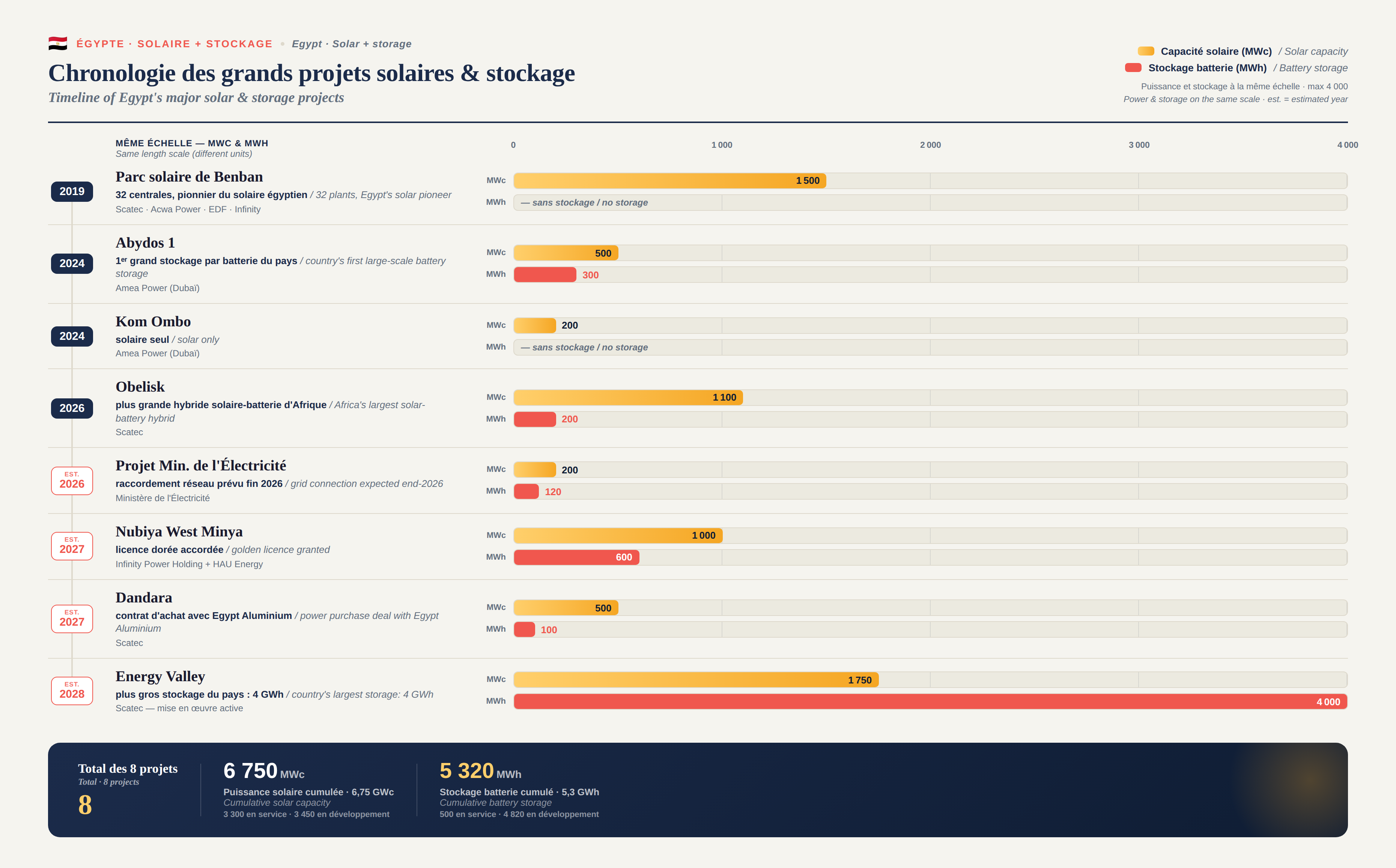
Egypt is accelerating the development of its solar sector as part of a wider strategy to meet growing energy demand and reduce its dependence on fossil fuels.
The country has set itself the target of generating 42 per cent of its electricity from renewable sources by 2030, with solar power playing a central role thanks to Egypt’s abundant sunshine and the falling costs of photovoltaic technology. These factors make large-scale solar projects particularly attractive in Egypt. Among the country’s flagship projects is the Benban solar park, one of the largest solar installations in the world, which has already commissioned nearly 1.5 GW of capacity spread across 32 solar parks. Other large-scale projects currently in operation include the 500 MW Abydos 1 solar power station, which is coupled with a 300 MWh battery storage system and owned by the Dubai-based developer Amea Power, as well as the same company’s 200 MW Kom Ombo photovoltaic project.
At the end of the first half of Egypt’s 2025/26 financial year, the Egyptian New and Renewable Energy Authority (NREA) reported a total installed renewable energy capacity of 9.1 GW, with solar and wind projects accounting for 6.2 GW. Further projects, amounting to several gigawatts, are currently under development and are expected to enable solar capacity to continue to grow.
The private sector: the driving force behind growth
The private sector’s commitment is the cornerstone of the accelerated development of solar energy in Egypt. At the time of the NREA report’s publication in January 2025, 20 MW of public-sector projects and 17.3 GW of private-sector projects were under construction or in the development pipeline up to 2030.
Egypt first established its framework for private sector participation in renewable energy in 2014, followed a year later by legislation that transformed the sector from a state monopoly into a competitive market. A feed-in tariff scheme launched in 2014 was subsequently replaced by a system of competitive ‘build-own-operate’ (BOO) tenders. More recently, direct contractual agreements between private stakeholders have opened up the market even further.
The Benban solar park is a perfect illustration of the Egyptian public-private partnership model. Developed under the feed-in tariff programme, the various power stations within the park are operated by leading developers, including the Norwegian company Scatec, the Saudi company Acwa Power, the French group EDF and the Egyptian company Infinity.
Integration of energy storage
As Egypt expands its solar capacity, battery energy storage systems (BESS) are playing an increasingly central role in grid integration, as they store surplus solar generation during periods of high output and release it during evening peak demand.
Among the leading operational examples, Scatec’s 1.1 GW Obelisk photovoltaic project, with a storage capacity of 200 MWh, which came online in August and is billed as Africa’s largest solar-battery hybrid facility to date.
Other large-scale projects combining solar power and storage are currently under development. The 1.75 GW ‘Energy Valley’ solar project, also led by Scatec, includes 4 GWh of BESS and has been described by the Egyptian government as being in the active implementation phase. The Norwegian company’s 500 MW ‘Dandara’ solar photovoltaic power station, with a storage capacity of 100 MWh, is also under development, according to information published by the EBRD; the electricity generated will be sold to Egypt Aluminium under a long-term ‘take-or-pay’ power purchase agreement.
Last month, the Egyptian State Information Service confirmed that the government had granted a ‘golden licence’ to the Nubiya West Minya project, with a capacity of 1 GW and a 600 MWh battery storage system, developed by a joint venture between Infinity Power Holding and HAU Energy. Last week, the Egyptian Ministry of Electricity announced a new 200 MW solar project combined with 120 MWh of storage capacity, which is due to be connected to the national grid by the end of 2026.
In February, the Egyptian Ministry of Electricity and Renewable Energy confirmed its intention to commission 600 MW of storage by 2026 in order to ensure grid stability and enable the deployment of a further 3 GW of solar capacity. According to a report by InfoLink, Egypt could add between 2.7 GW and 4.5 GW of storage capacity by 2028, equivalent to a storage capacity of between 6.2 GWh and 12 GWh.
Whilst large-scale lithium-ion batteries dominate projects currently under development, Egypt is also exploring other storage mechanisms, including pumped-storage hydroelectric power stations and compressed air energy storage, according to government reports.
Supporting capacity building
The rapid expansion of renewable energy in Egypt requires substantial investment in grid infrastructure. The government has allocated 26.5 billion Egyptian pounds ($532 million) for the 2024/2025 financial year and 45 billion Egyptian pounds for 2025/2026 to modernise the electricity transmission infrastructure. The Egyptian Electricity Transmission Company (EETC) is upgrading the capacity of substations and extending high- and extra-high-voltage transmission lines, with 819 substations now operational across a 61,000-kilometre transmission network.
International partnerships are helping to accelerate these efforts. A €690 million ($800 million) financing package from the European Union and the European Investment Bank aims to integrate 22 GW of renewable capacity into the Egyptian grid by 2030. One of the flagship projects is a 61.6-kilometre, 500 kV transmission line, worth 20 billion Egyptian pounds, linking renewable energy projects in the Gulf of Suez to the Hawamdiya substation, south of Giza.
These infrastructure upgrades are designed to reduce transmission losses, improve grid reliability and provide the flexibility needed to accommodate the intermittent output of renewable energy sources and large-scale battery storage systems.
Why is this important? The expansion of solar power in Egypt is increasingly reliant on the coordinated deployment of infrastructure and storage systems. For solar developers and engineering, procurement and construction (EPC) contractors, the transition to ‘solar + storage’ hybrid projects requires more in-depth technical expertise in battery integration and interactive grid controls, whilst equipment suppliers can expect growing demand for battery management systems, DC/AC converters and grid-forming inverters.
Policy-makers in other African countries may look to Egypt as a model to follow for the large-scale integration of distributed solar systems combined with storage; a model that grid operators across the continent will likely need to adopt as the penetration of renewable energy increases and battery costs continue to fall.
Sources: New and Renewable Energy Authority, Egyptian State Information Service, Ministry of Electricity and Renewable Energy, Egyptian Electricity Transmission Company